A primer
How to read
a fragrance.
A scent is not one smell but a sequence — and the words on a bottle are a kind of map. Here is what they mean, in plain language, so you can choose by understanding rather than guesswork.
01 · The oil
Concentration
Every fragrance is perfume oil dissolved in alcohol. The concentration is simply how much of it is oil — and that single number shapes everything else. Eau de Toilette sits around 5–15%, bright and fleeting. Eau de Parfum runs 15–20%, fuller and longer. Parfum (or extrait) climbs higher still.
ARKEN bottles eau de parfum at a deliberately high oil load — richer on the skin, slower to leave, and closer to the way the raw material actually smells. More oil is not louder; it is deeper.
02 · The shape
Notes &
the pyramid
A fragrance is read in three acts, because its ingredients evaporate at different speeds. Together they are called the pyramid.
- Top notes The opening — the first few minutes. Bright, volatile, the first impression that then lifts away: citrus, herbs, a cool spike of green.
- Heart notes The body of the scent, arriving as the top fades — usually fifteen to thirty minutes in. This is the character you actually wear: florals, spice, fruit, tea.
- Base notes The dry-down, hours later, and what lingers on a scarf the next day. The heavy, slow materials — woods, resins, oud, musk, vanilla — that hold everything in place.
When you read a fragrance on paper after one minute, you have met only its top. Give it the heart and the base before you judge.
03 · How long
Longevity
How long a scent lasts on your skin before it fades to a whisper. It depends on the concentration, on the weight of the base notes, and — more than people expect — on you: warm or dry skin, the weather, even what you ate all move the number.
ARKEN's eau de parfum is built to hold ten to twelve hours. A skin that runs dry will shorten that; a dab of unscented balm first will lengthen it.
04 · How far
Sillage
From the French for wake — the trail a scent leaves behind you, and how far it travels into a room. A skin scent stays intimate, found only when someone leans close. A room-filling sillage announces itself from the doorway.
Neither is better. It is a question of intention: what you want a fragrance to do in the space around you.
05 · The wait
Maceration
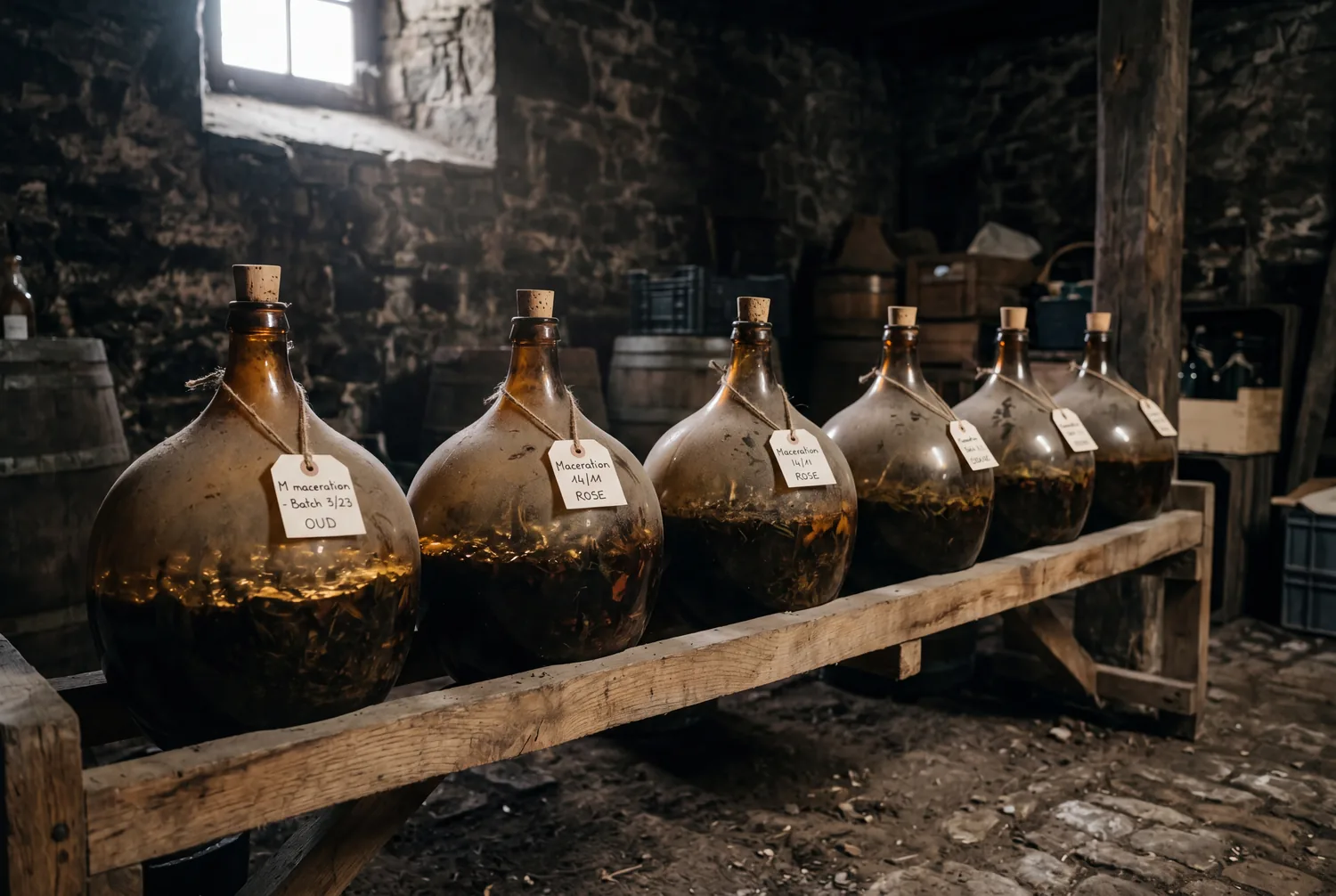
Once the oils and alcohol are blended, the liquid is left to rest — for weeks — before it is ever bottled. In that time the raw materials marry instead of merely mixing: rough edges settle, the notes knit into one another, and the whole becomes rounder and more itself.
It is the slowest, least visible step, and the easiest to skip. We don't. Read why we wait →
06 · In practice
How to test
& wear
- Wear it on skin Paper shows you the top notes and little else. Your skin's warmth is what unfolds the heart and base.
- Give it thirty minutes Judge a fragrance by its heart, not its first breath. Most regret comes from deciding too early.
- Never rub your wrists Friction fractures the delicate top notes and warms the scent unevenly. Dab, and let it settle.
- Find your pulse points Wrists, the side of the neck, the inner elbow — warm spots that lift the scent gently through the day.
- Try one at a time The nose tires quickly. Three scents at once become mud. This is why we made the Discovery Kit a day each, not an hour.
Know what you're smelling, and the choosing becomes easy.
Every word here began as a material.