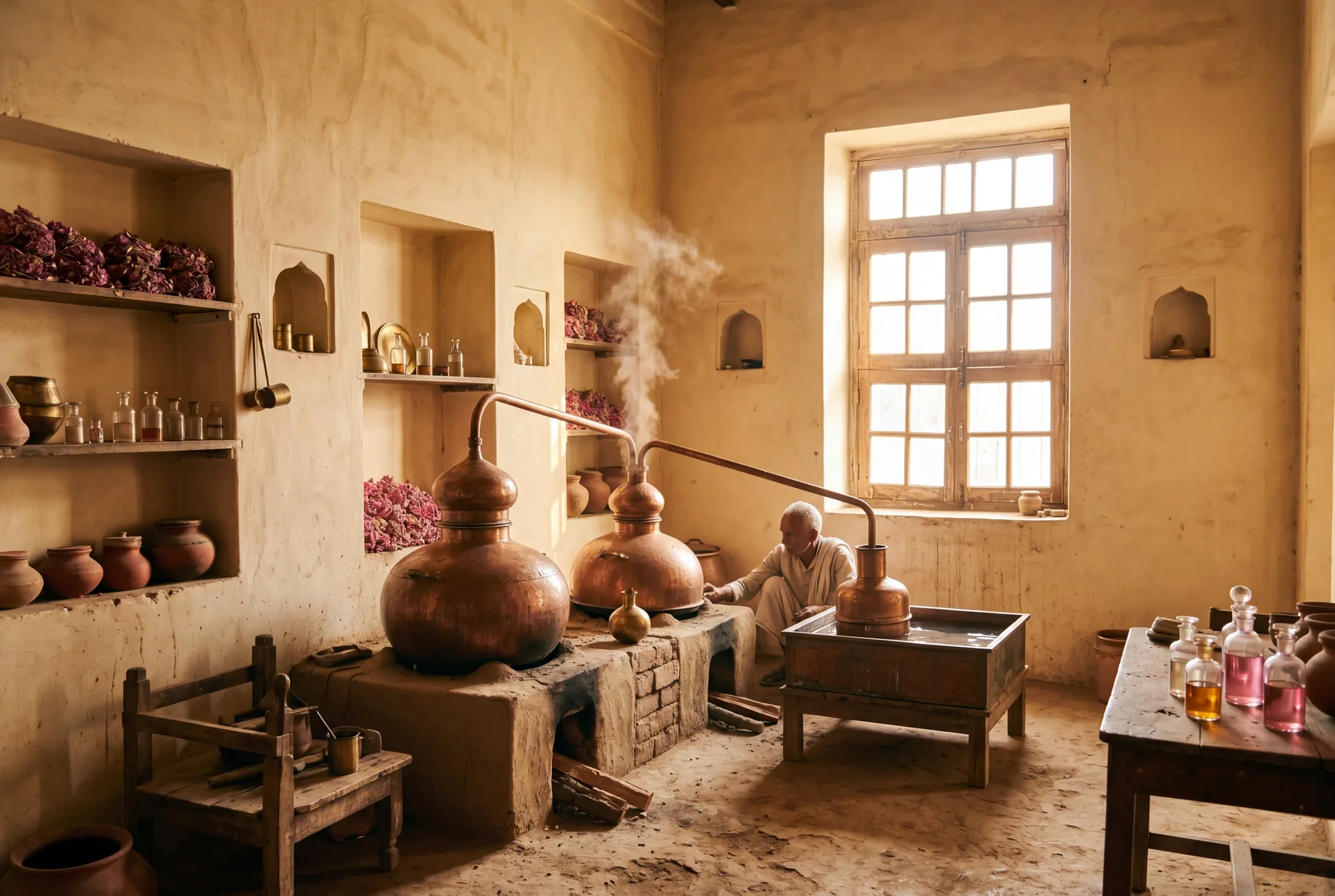
Long before the word perfume reached a French invoice, a small town on the Ganges plain was already distilling scent from the ground itself. Kannauj has been doing this for six hundred years. The world simply never thought to ask its name.
Grasse, in the south of France, is spoken of as the birthplace of modern perfumery — its jasmine and rose fields, its houses, its generations of noses. The story is true, and it is also incomplete. Two and a half thousand kilometres east, Kannauj has run an unbroken tradition of steam distillation since the sixteenth century, supplying the courts of Awadh and, later, half the attar of the subcontinent. It is not an imitation of Grasse. It is its older, quieter cousin.
The deg and the bhapka
The method has barely changed. Botanicals — rose, jasmine, vetiver, the wood of the night — are loaded into a copper still, the deg, sealed with cotton and clay, and set over a wood fire. The vapour travels through a bamboo pipe into a receiver, the bhapka, that sits submerged in cool water and already holds a base of sandalwood oil. There is no thermometer. The distiller reads the still by the sound of the boil and the weight of the receiver in the hand, swapping vessels by instinct across a twelve-hour day. It is among the most demanding crafts in all of perfumery, and it is done almost entirely without instruments.
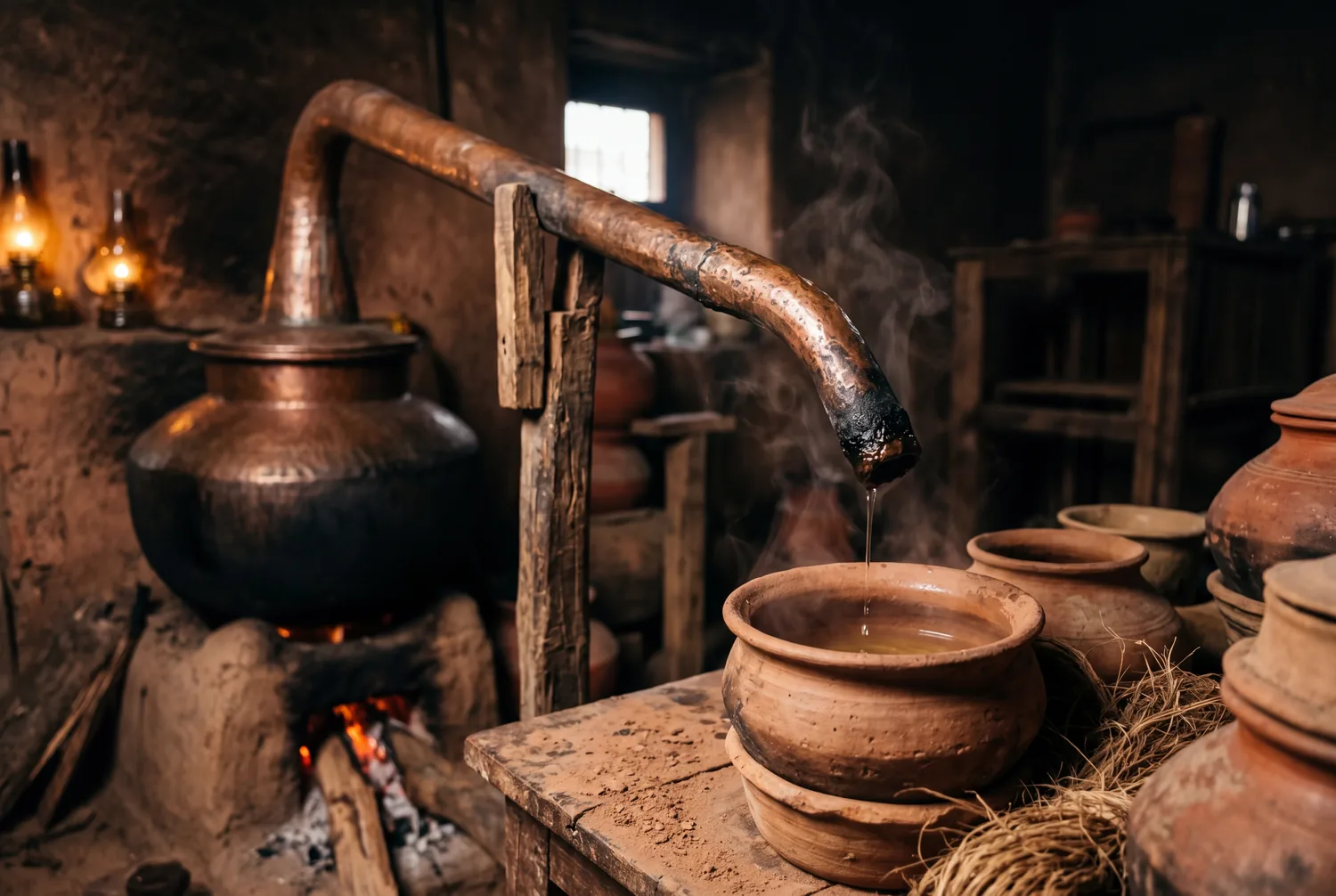
The most Indian smell in existence is not a flower. It is the ground, the moment before the rain.
Mitti — the scent the world has no word for
Of everything Kannauj produces, one material has no equivalent anywhere on earth. To make mitti attar, distillers take baked discs of the local clay — earth, literally — and run the steam through them. What condenses is petrichor: the precise smell of the first monsoon rain striking hot, dry ground. It is bottled into sandalwood and sold by the tola. Western perfumery has the chemistry to gesture at it — geosmin, a molecule the human nose detects at five parts per trillion — but it has no tradition of capturing it. Kannauj has done so for centuries, and barely anyone outside India knows.
This is the strange position Indian materials have occupied for a very long time. The finest sandalwood, the origin of oud, the only place that distills the rain — and not one globally credible house built on top of them with India's name on the bottle. The materials travelled. The authorship stayed behind.
Why we started here
When we built Before the Rain, we did not reach for mitti as a flourish. We built the entire composition around it — green cardamom and a breath of aldehydes above, the wet mineral earth and Uttarakhand vetiver at the heart, a clean musk beneath to carry it through Indian heat. The brief was a single sentence: bottle the charged air before the monsoon breaks, and make it last past noon.
Kannauj does not need to be discovered. It needs to be named. That is the whole of our work — to take materials the world already depends on and present them, finally, under the house that made them.